
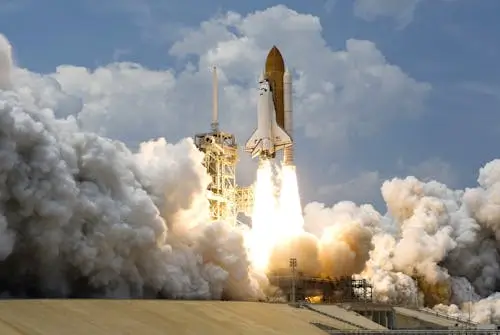
Imagine trying to swim without water! That’s what a car engine would be like in space—it needs air (specifically the oxygen in the air) to burn its fuel.
The secret of a rocket engine is that it doesn’t rely on the air around it. Instead, it carries everything it needs right inside its massive tanks:
Fuel: This is the stuff that burns, like kerosene, methane, or liquid hydrogen.
Oxidizer: This is the “air” or, more accurately, the oxygen the fuel needs to burn. Rockets usually carry this as liquid oxygen (LOX).
By carrying both the fuel and the oxidizer, a rocket can create a huge, powerful fire—called combustion—anywhere, even in the vacuum of space!
The “Action-Reaction” Power
The combustion happens in a special place called the combustion chamber. When the fuel and oxidizer mix and ignite, it creates a massive explosion of extremely hot gas.
These hot gases are then forced out of the rocket through a small opening called a nozzle at an incredibly high speed.
This is where the magic of physics comes in, thanks to Sir Isaac Newton’s Third Law of Motion. This law simply says:
For every action, there is an equal and opposite reaction.
Action: The rocket engine forces the hot gases down and out very powerfully.
Reaction: The force of those gases being pushed out creates an equal and opposite force that pushes the rocket up!
It’s like when you let go of an inflated balloon without tying it: the air rushes one way (the action), and the balloon shoots off in the opposite direction (the reaction). The rocket is doing the same thing, but with a controlled, giant explosion!
Staying in Space: A Balancing Act
Once a rocket is in orbit, it has to follow a few more rules:
Orbiting Speed: To stay around Earth, a spacecraft has to be moving at a specific speed for its height. If it goes too slow, gravity will pull it down!
Atmospheric Drag: Even in space, there’s a tiny bit of leftover air (atmosphere) that creates drag (like friction) on things like the International Space Station (ISS). This drag slows them down over time.
Maintenance: Because of the drag, spacecraft must fire their engines periodically (every now and then) to gently push themselves back up to the correct speed and altitude. This is why they need to carry a little bit of extra fuel!
Rocket scientists have to be very smart and precise. They measure how efficient their fuel is—how much push (thrust) they get for a certain amount of fuel burned. This measurement is called specific impulse. Choosing the best fuel and carrying just the right amount of it is crucial to launching a successful and affordable mission!